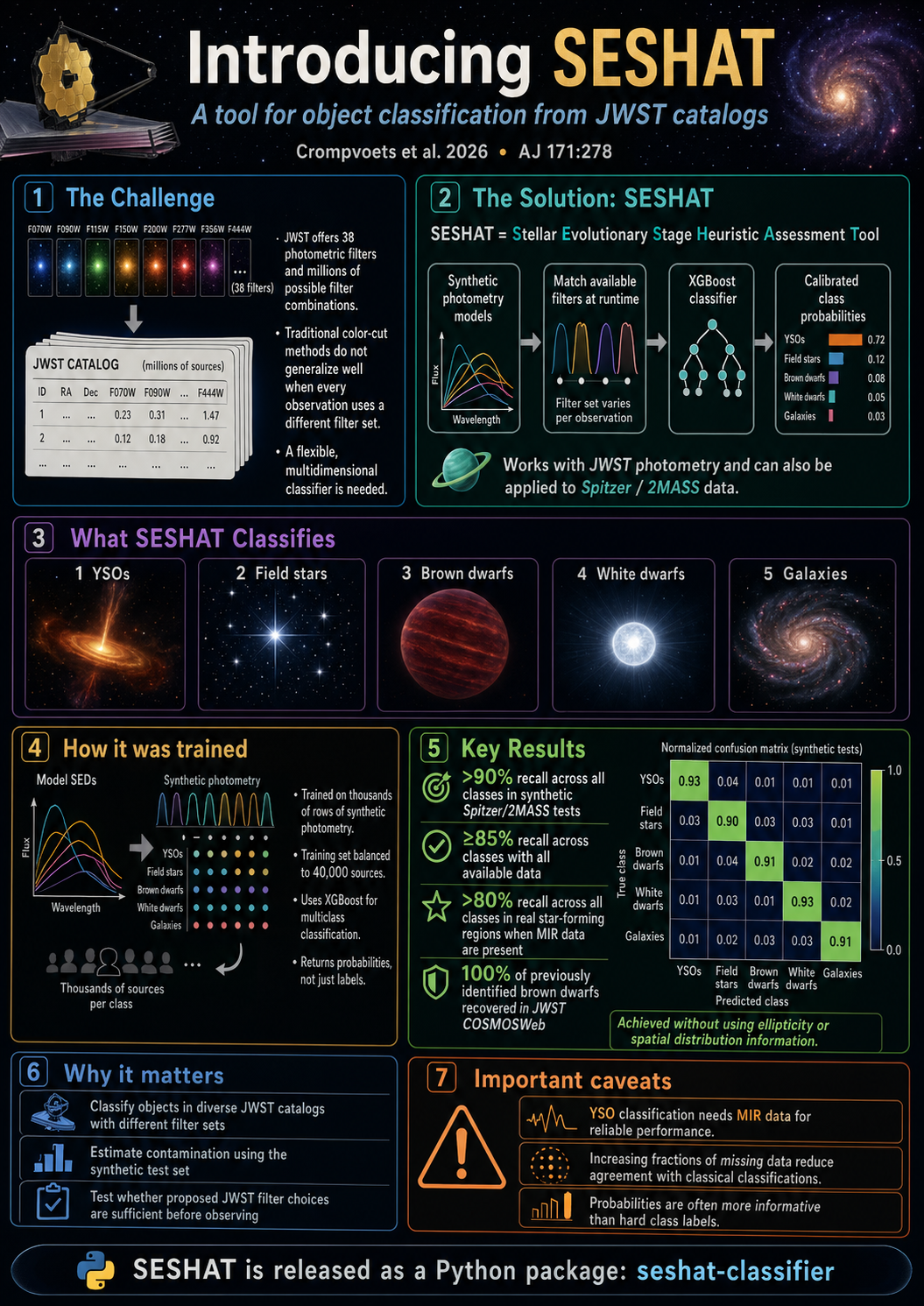
How do you find a single “failed star” in a sea of a million distant galaxies? Since its launch, the James Webb Space Telescope (JWST) has been flooding Earth with breathtakingly detailed data, but this wealth of information comes with a massive logistical headache: we have more data than we have people to sort it.
Enter SESHAT (the Stellar Evolutionary Stage Heuristic Assessment Tool). Developed by lead author Breanna L. Crompvoets of the NRC Herzberg Astronomy and Astrophysics Research Centre, this new machine-learning tool acts as a sophisticated cosmic librarian. In a study recently published in The Astronomical Journal, researchers revealed that SESHAT can identify everything from “baby” stars to ancient “dead” stars with over 85% accuracy, regardless of which of the telescope’s many filters are being used.
The Library of 38 Colours: Why Classical Sorting Failed
Before SESHAT, astronomers relied on a method called “colour cuts.” Imagine you are trying to sort a basket of fruit, but you are only allowed to look at how red an object is, or how green. You might successfully separate the apples from the limes, but you’d likely confuse an apple with a tomato.
In astronomy, these “colours” are actually a comparison between different filters that capture specific wavelengths of light. The JWST is equipped with 38 different photometric filters (tools that measure the brightness of light in specific ranges). Because every scientific team uses a different combination of these filters, the old “colour cut” rules—which worked for older telescopes with fewer options—simply couldn’t keep up. We were essentially trying to use a map of a small village to navigate a sprawling metropolis.
The Discovery: Training an AI to See the Full Spectrum
The team created SESHAT using a machine-learning method called XGBoost. Rather than looking at just two “colours” at a time, the AI looks at every available dimension of data simultaneously.
To teach the AI what to look for, the researchers didn’t just use real photos; they used thousands of synthetic models—perfectly calculated digital versions of various celestial objects. These models included:
- Young Stellar Objects (YSOs): “Baby” stars still wrapped in their birth cocoons of gas and dust.
- Brown Dwarfs: Often called “failed stars,” these are objects larger than planets like Jupiter but not quite heavy enough to ignite like our Sun.
- White Dwarfs: The small, dense, glowing embers left behind after a star like our Sun dies.
- Field Stars and Galaxies: The “background” noise of the universe that can often mask the rarer objects astronomers are looking for.
The researchers even added “realistic effects” to their training data, such as extinction (the dimming of light caused by space dust) and PAH emission (light patterns from large molecules that can “contaminate” the image of a star).
When they tested SESHAT on real data from the COSMOS-Web survey, the tool successfully recovered 100% of previously identified brown dwarfs. It also proved that for identifying baby stars (YSOs), having data from the Mid-Infrared Instrument (MIRI) is absolutely essential; without those specific “heat-vision” filters, the AI would often mistake a baby star for a distant galaxy.
What’s Next: A GPS for Cosmic Proposals
SESHAT isn’t just for sorting through photos we’ve already taken; it’s a tool for the future of space exploration. Astronomers can now use SESHAT to test their proposals before the telescope even moves. By plugging their intended filter choices into the tool, they can see if those filters will actually be enough to identify the specific stars or galaxies they are looking for.
This “predictive” power ensures that precious time on the world’s most advanced telescope isn’t wasted on observations that might leave researchers guessing.
A New Map for a Big Universe
As we move deeper into the “Big Data” era of astronomy, tools like SESHAT represent a fundamental shift in how we understand our place in the cosmos. By combining the raw power of the JWST with the precision of machine learning, we are finally building a map of the universe that is as complex and varied as the stars themselves. SESHAT is more than just a piece of software; it is a testament to human ingenuity, helping us find the needle of discovery in a haystack of a billion suns.